The trademark mutton chop sideburns may have been shorn, and the sweatbands were now red and white rather than black and white, but when striker Malcolm Macdonald moved from Newcastle United to Arsenal in July 1976 for an eye-catching £333,333 fee, it was clear that he’d lost none of his self-confidence.
In stark contrast to today’s savvy footballers not wanting to add pressure to themselves, the 26-year-old promised upon his arrival in north London: “I’ll score 30 goals this season.”
‘Supermac’ - as fans at both clubs nicknamed him - certainly buckled plenty of swash. On the pitch, with his powerful build and dazzling pace, there were few more thrilling sights than Macdonald in full flow. He still holds the England record for most goals scored in a competitive match when he sensationally scored five times against Cyprus in 1975.
Off it, he was the embodiment of an upwardly mobile ‘70s footballer, with business interests in a fashion boutique and a car showroom and a weekly tabloid column. There was also a notable performance during the popular TV show Superstars, in which Macdonald clocked an incredible time of 10.5 seconds in the 100 metre sprint.
He was adored at Newcastle as soon as he pitched up at St James’ Park from Luton Town in 1971, with a hat-trick on his debut against Liverpool helping no end. Describing his relationship with the Toon Army, he recalled: “They were our twelfth man every match, and provided an amazing backdrop of noise.”

He won the First Division Golden Boot in 1975, a year after blasting the Magpies to the FA Cup final but silverware eluded him on Tyneside. He remains their fifth-highest goalscorer in their history, with 138 goals netted in 257 games in all competitions.
While the start to his Magpies career was emphatic, the end saw the fiery Macdonald fall out with manager Gordon Lee and was on his way back to his native London. After a slow start, he came good when Newcastle came to town in December, scoring a hat trick in a 5-3 thriller to punish his former club. The first goal, headed home from an Alan Ball cross, was classic Macdonald.
His insistence that he’d hit the 30-goal mark in his first season at Highbury almost proved to be unerringly accurate, and he’d miss his target by just a single goal, but still claimed a second Golden Boot.
There were further spats with management as Terry Neill controversially sent Supermac home from a pre-season tour to Australia and the Far East - but his self-confidence and obsession with hitting the back of the net remained undimmed.
When Arsenal defeated Orient 3-0 at Stamford Bridge in the 1978 FA Cup semi-final to reach Wembley, Macdonald claimed a brace, even though both of his shots took massive deflections on the way into the net. “There was no way he wasn’t adding those to his tally,” laughed his strike partner, Frank Stapleton.
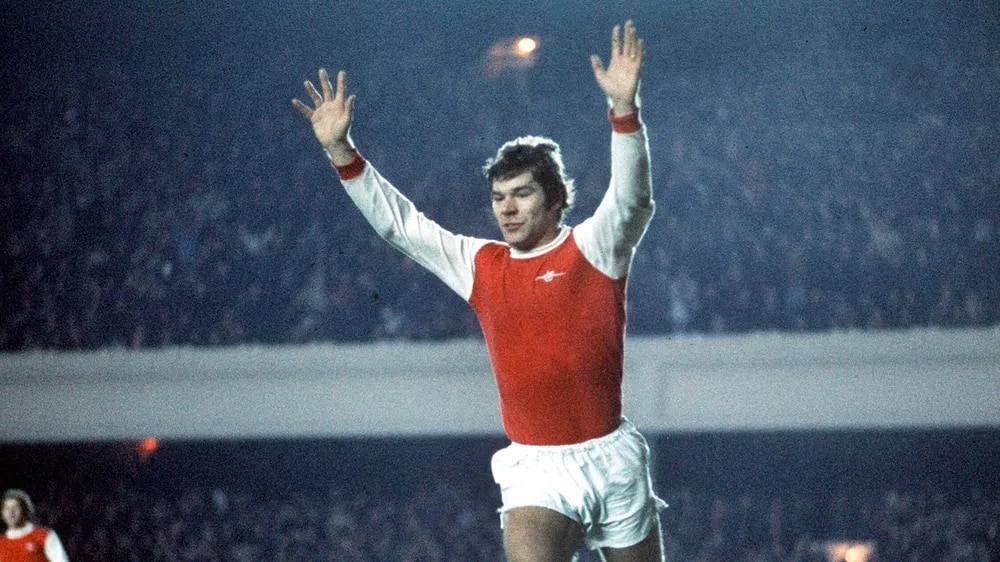
Macdonald’s insipid display in the final against Ipswich Town, which Neill’s side lost 1-0, was in no small part due to the effects of a torn cartilage sustained at the start of the campaign. “Two or three times I went to make a run at Wembley, and the knee locked. I couldn’t move,” lamented Macdonald.
Macdonald missed almost the whole of the 1978/79 campaign due to injury. His final appearance in a Gunners shirt came against relegated Chelsea at Stamford Bridge two days after the FA Cup final victory over Manchester United. He scored, of course, meaning he’d notched 57 goals in just 107 matches, but premature retirement came soon afterwards. “I walked out of Highbury’s marble halls and looked down St Thomas’s Road. It was the loneliest feeling in the world,” he told me in our most recent interview.
Fans at both St James Park and Highbury could count themselves lucky to have watched the thrilling exploits of the most charismatic of all ‘70s strikers. “Goals enabled me to connect with crowds, and I was privileged to be able to score so many, for two great clubs,” he said.